
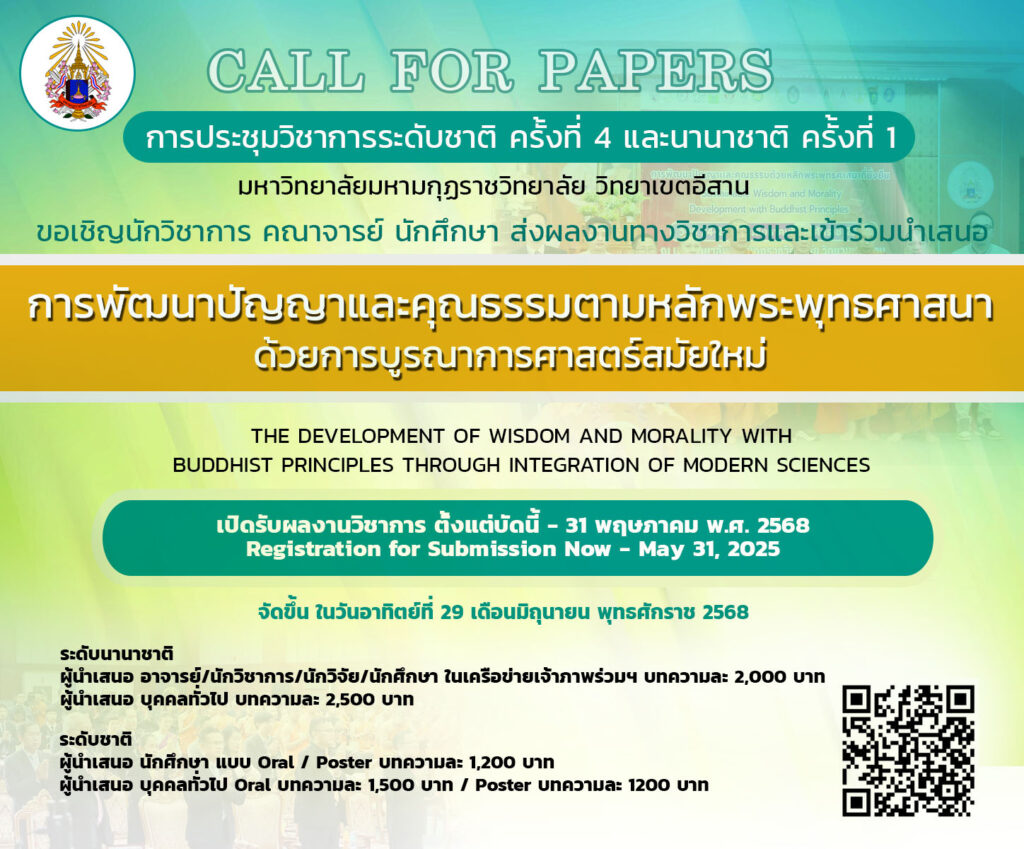
Rationale The world in the 21st century is facing disruptive change (Disruption) in every dimension, including technology, the economy, society, and the environment. This was clearly seen in the recent COVID-19 pandemic, which severely affected the ways of life of people around the world and forced every sector to adapt in order to survive, particularly education, which had to change its teaching and learning methods abruptly. At the same time, society is facing multiple crises, including environmental problems, social conflict, economic problems, and moral decline. Development that focuses only on material progress while neglecting the mental and intellectual dimensions has created problems that are complex and difficult to solve.
Education is therefore a vital foundation for improving people’s quality of life and for sustainable social development. This is evident in the fact that the United Nations (UN) has set education as one of the 2030 Sustainable Development Goals (SDGs), namely Goal 4 on promoting equitable education and lifelong learning for all. This is consistent with the 20-Year National Strategy (2018-2037), which sets the framework and direction of development to achieve the vision “Thailand is secure, prosperous, and sustainable.”
In this situation, Buddhism, as a valuable body of knowledge and wisdom handed down for more than 2,500 years, plays an important role as a tool for developing people with wisdom and virtue who can face the challenges of a rapidly changing world with stability. Buddhist teachings are profound, covering both self-development and peaceful coexistence in society. They emphasize holistic human development through the Threefold Training (morality, concentration, and wisdom), a learning process that develops people to become ones who know, are awakened, and are joyful.
As a Buddhist educational institution committed to producing quality graduates who lead in research and in academic service to society, Mahamakut Buddhist University recognizes the importance of sustainably developing wisdom and morality through Buddhist principles. This is consistent with the classification of higher education institutions by the Ministry of Higher Education, Science, Research and Innovation (MHESI), which places the university in Group 4: Development of Wisdom and Morality through Religion. The university’s philosophy is “Academic Excellence in Accordance with Buddhism.”
Applying the teachings of Buddhism to the development of wisdom and virtue in today’s society therefore not only helps solve human social and psychological problems but also leads to sustainability in every dimension: economic, social, and environmental. In other words, when people have the wisdom to understand the nature of life and the world as they truly are, understand causes and conditions, live with sufficiency, and have loving-kindness and compassion toward all living beings, they will lead lives that are friendly to nature and the environment, maintain good relationships with others, and carry out economic activities that harm no one.
For this reason, Mahamakut Buddhist University, Isan Campus, has organized a national and international academic conference under the theme “Through the Integration of Modern Sciences” to serve as an academic forum for researchers, students, and interested persons to present their research and exchange knowledge in education, educational administration, leadership, Buddhism and philosophy, political science, government, public administration, social work, Thai language teaching, and social studies teaching. The conference seeks to integrate these disciplines with Buddhist principles, leading to higher-quality research and innovations that benefit sustainable social development.
Objectives
- To create a forum for exchanging knowledge and disseminating research that integrates various disciplines with Buddhist principles for sustainable social development.
- To integrate Buddhist teachings with modern disciplines to solve problems and develop society sustainably, and to develop educational research and innovation that integrates Buddhist principles for concrete application in solving problems and developing society in various dimensions.
- To build a network of academic and research collaboration among scholars, researchers, students, and interested persons from various educational institutions to advance the development of wisdom and morality according to Buddhist principles in all sectors of society.
| Date/Time | Submission Schedule |
|---|---|
| 15 February - 31 May 2025 | Call for Abstracts |
| 31 May 2025 | Abstract Submission Deadline |
| 5 June 2025 | Announcement of Abstract Review Results |
| 5 – 15 June 2025 | Revise the abstract according to the suggestions of the Peer Reviewers who evaluate the work |
| 16 - 26 June 2025 | Payment of Registration Fees |
| 29 June 2025 | Academic Conference and Presentation Day |
| From today – 31 May, 2025 | Begin receiving research papers |
| 31 May, 2025 | Deadline for receiving papers |
| 5 – 15 June, 2025 | Announcement of selected paper |
| 16 – 26 June, 2025 | Payment of Registration |
| 29 June, 2025 | National & International Presentation In The Sustainable Development of Wisdom and Morality with Buddhist Principles Though Integration of Modern Interdisciplinary Science |
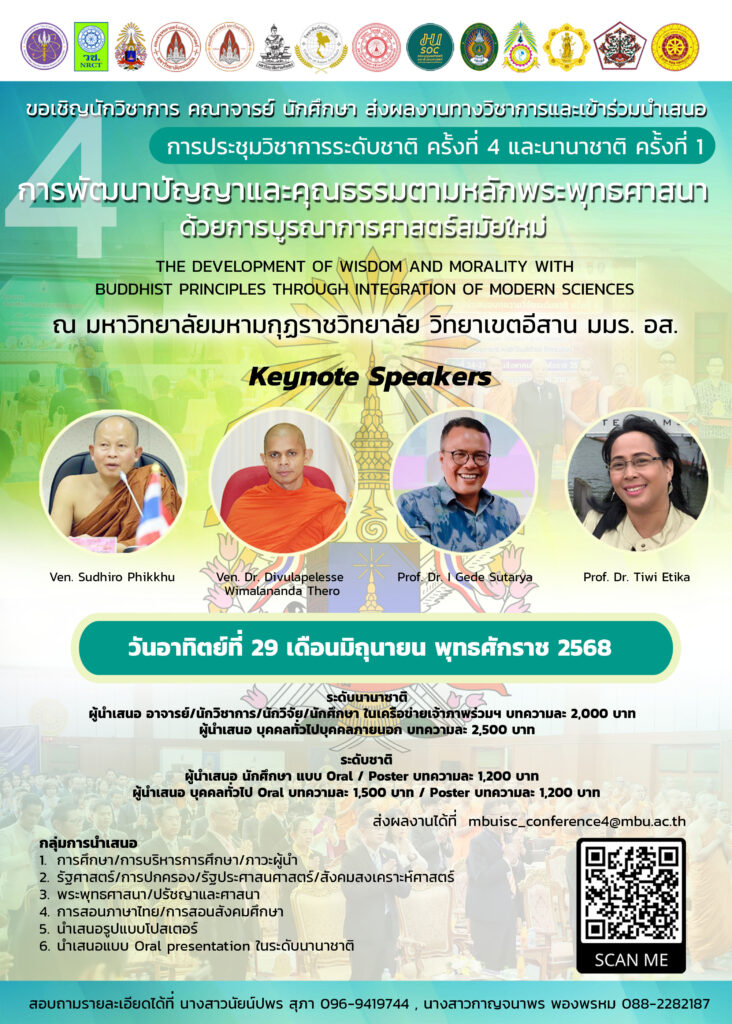
| No. | Group | Venue |
|---|---|---|
| 1. | Education/Educational Administration/Leadership | Meeting Room, 2nd Floor, Sirindhorn Academic Resource Center Building |
| 2. | Political Science/Government/Public Administration/Social Work | Graduate School Meeting Room, 1st Floor, Sirindhorn Academic Resource Center Building |
| 3. | Buddhism/Philosophy and Religion | Seminar Room 3, 2nd Floor, Seminar Building |
| 4. | Teaching Thai/Teaching Social Studies | Seminar Room 1, 2nd Floor, Seminar Building |
| 5. | Poster Presentation | Open Area beneath the Sirindhorn Academic Resource Center Building, 1st Floor |
| 6. | Oral Presentation at the International Level | Meeting Room, 1st Floor, Seminar Building |